

NYC property managers must maintain buildings free of pests, use Integrated Pest Management (IPM) for infestations, and file annual bed bug reports. Failure to comply with these rules results in HPD violations, escalating fines, and potential receivership. Broadway Pest Services provides the documented IPM programs required to satisfy these regulatory demands.
The Legal Obligation to Maintain Pest-Free Premises
New York City law places the primary responsibility for pest control on building owners and managers. The NYC Department of Health and Mental Hygiene (DOHMH) requires that all residential and commercial properties be maintained free from pests, including mice, rats, roaches, and other insects. This is not merely a recommendation; it is a legal mandate enforced through the Housing Maintenance Code and the Health Code.
Building owners must take appropriate steps to control pests, which includes hiring a licensed pest professional, ensuring proper waste storage, and repairing structural holes or cracks that allow entry. According to the NYC Department of Health, spraying chemical pesticides alone does not address the root causes of pest problems. Managers must address the underlying conditions, such as moisture or food sources, that attract pests in the first place.
For property managers, this means that a reactive approach to pest control is legally insufficient. You must demonstrate proactive maintenance. If a tenant files a 311 complaint, the Department of Housing Preservation and Development (HPD) will inspect the property. If the inspection reveals pests and a lack of documented preventive measures, the property will be cited for a Class B violation.
Integrated Pest Management as a Regulatory Standard
Integrated Pest Management (IPM) is a systematic approach to pest control that prioritizes prevention, monitoring, and targeted treatment over broad-spectrum chemical spraying. In New York City, IPM is the standard regulatory framework expected for managing pest infestations in residential buildings. The city has moved away from a "spray-and-pray" model, requiring managers to identify the specific pest species and address the environmental factors that support their population.
Local Law 55 and Title 28 Rules of the City of New York section 54-04 mandate safe work practices when assessing and correcting underlying defects that may have caused an infestation. As noted in the December 2025 HPD Bulletin to Property Owners, remediation must use IPM to address pest infestations. This includes sealing entry points, managing waste, and using the least toxic effective methods for control.
For a property manager, the implication is that your pest control vendor must provide more than just treatment. They must provide a documented IPM plan. This plan should detail the identification of pests, the monitoring methods used, the thresholds for treatment, and the specific preventive actions taken. Broadway Pest Services builds these documented IPM programs to ensure that your records hold up during HPD inspections or housing court proceedings. according to Pest Control Information
Annual Bed Bug Reporting and Local Law 69
Local Law 69 requires all multiple-dwelling building owners in New York City to file an Annual Bed Bug Report with HPD by December 31 each year. This law was enacted to increase transparency and accountability regarding bed bug infestations in residential buildings. Failure to file this report is a separate violation that carries fines, regardless of whether an active infestation is present.
The report must include data on the number of units with bed bug infestations, the dates of treatment, and the methods used. This data is public and can be accessed by tenants, prospective buyers, and regulators. For property managers, this creates a direct link between pest control operations and legal compliance. If your pest control company does not track unit-level infestation data, you cannot accurately file the required report.
Bed bugs are particularly challenging because they can enter homes by latching onto used furniture, clothing, or luggage, as explained by the NYC DOHMH. Because of this, prevention and early detection are critical. A robust pest control program includes regular inspections of high-risk areas and immediate response to tenant reports. Broadway Pest Services provides the unit-level data tracking necessary to ensure your Local Law 69 filing is accurate and timely.
HPD Violations, Fines, and Receivership Risk
HPD classifies pest violations as Class B (hazardous) violations. These violations require correction within 30 days and carry fines that escalate significantly if uncorrected. A single 311 complaint can trigger an HPD inspection within one to two weeks for priority complaints. If the inspector finds pests and no documented IPM program, the property will be cited. The initial fine for a Class B pest violation starts at $300, but it can escalate to over $1,000 per unit per cycle if the violation remains uncorrected.
Repeated violations create a pattern of neglect that exposes the building to greater legal risk. Buildings with patterns of uncorrected Class B and C violations risk 7A receivership proceedings. In a 7A proceeding, a court-appointed administrator takes over the management of the building. This is a severe outcome that can strip owners of control and lead to significant financial loss. Documented IPM is one of the strongest defenses against receivership because it demonstrates active management rather than neglect.
Property managers must understand that pest control is not just a maintenance issue; it is a legal defense. When you contest a violation at the NYC Office of Administrative Trials and Hearings (OATH), active IPM documentation showing regularly scheduled pest control, service logs, and corrective action records significantly increases your chance of fine reduction or dismissal. Judges regularly reduce penalties for establishments with demonstrated compliance efforts.
Documentation as Your Primary Legal Defense
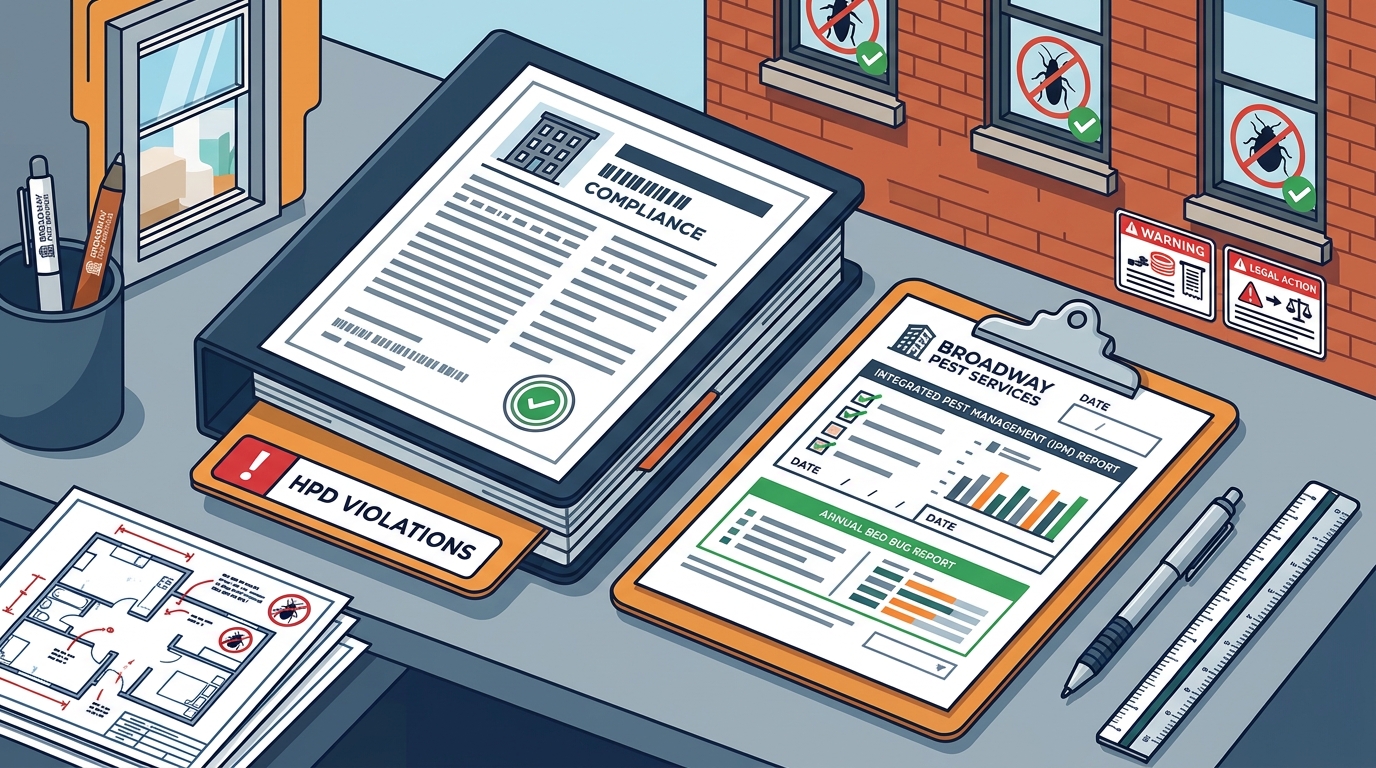
Documentation is the product of a compliant pest control program. Pest control is the service, but the records generated by that service are what protect you in legal proceedings. Every service visit should produce a digital log that includes the date, time, technician license number, areas inspected, activity observed, treatments applied, and the next scheduled visit. These logs must be accessible 24/7 and formatted for HPD review.
When an HPD inspector arrives, they do not just ask if you have pests; they ask what you are doing about pest risk. Compliance means being able to produce accurate logs, invoices, inspection notes, and trend reports the moment someone reviews records or walks the property. If you have a consistent, professional pest program and clear records to match, it shows that any issue they find is being handled, not ignored.
Broadway Pest Services provides a 24/7 client portal where all service records are accessible around the clock. Whether you need documentation for an HPD inspection, a building board meeting, or your own records, your compliance paper trail is always current and available. This level of documentation is essential for property managers who want to protect their portfolio from fines and legal action.
Key Takeaways
- Building owners are legally required to maintain premises free of pests and use IPM for infestations.
- Local Law 69 mandates annual bed bug reporting with HPD by December 31.
- HPD Class B pest violations carry fines that escalate to over $1,000 per unit if uncorrected.
- Repeated violations can lead to 7A receivership proceedings.
- Documented IPM programs are the primary defense in OATH hearings and HPD inspections.
- Pest control vendors must provide unit-level data tracking for accurate Local Law 69 filings.
- Proactive prevention and monitoring are legally required, not just best practices.
Frequently Asked Questions
What is the penalty for failing to file the annual bed bug report?
Failure to file the Annual Bed Bug Report required by Local Law 69 is a separate violation carrying fines up to $1,000. This applies regardless of whether an active infestation is present in the building.
How quickly does HPD inspect after a 311 complaint?
HPD typically inspects within one to two weeks for priority complaints. The timing can vary based on the severity of the complaint and current inspection backlogs, but managers should be prepared for a rapid response.
Does spraying pesticides alone satisfy NYC compliance requirements?
No. The NYC DOHMH states that spraying chemical pesticides alone does not get at the root of pest problems. Compliance requires addressing underlying conditions and using Integrated Pest Management (IPM) strategies.
What documents should a property manager have ready for an HPD inspection?
You should have written IPM plans, routine monitoring schedules, service records and logs for each visit, documented treatment methods, and device maps for traps and monitors. These documents demonstrate due diligence and proactive management.
Can a pest control company help with Local Law 69 reporting?
Yes. A compliant pest control provider should track unit-level infestation data and provide the specific data points required for the Local Law 69 filing. Broadway Pest Services provides this data through its 24/7 client portal.
What is the difference between a Class A and Class B HPD violation?
Class A violations are non-hazardous and require correction within 90 days. Class B violations are hazardous, including pest infestations, and require correction within 30 days. Class B violations carry higher fines and greater legal risk if uncorrected.
Protect Your Portfolio with Compliant Pest Management
Compliance with NYC pest control rules is not optional; it is a core business risk that requires a structured, documented approach. By implementing a documented IPM program, filing accurate Local Law 69 reports, and maintaining 24/7 access to service logs, you protect your property from fines, legal action, and receivership. Broadway Pest Services has been serving NYC commercial and residential properties since 1970, providing the documented, compliance-ready pest control programs that the city's regulatory environment demands. To ensure your property is protected, for a free assessment.