

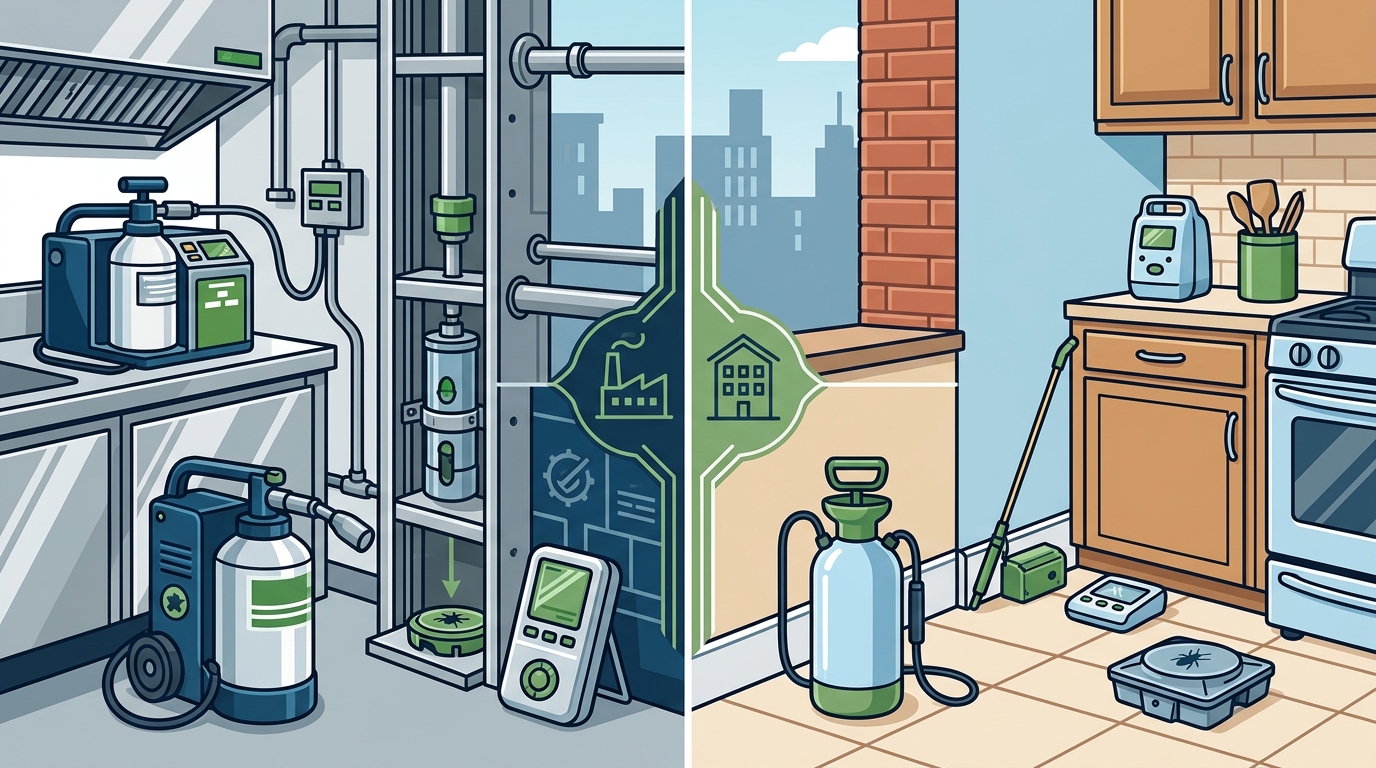
Pest management in New York City is not a one-size-fits-all operation. The regulatory environment, tenant expectations, and structural complexities of Manhattan and the five boroughs demand specialized approaches. While the goal is always the same, eliminating pests, the methods used to achieve that goal differ drastically depending on whether you are managing a high-rise apartment or a commercial food processing facility. Understanding these distinctions is critical for property owners and managers to ensure compliance, protect reputation, and maintain operational continuity. (Broadway Pest Services Urban)
Regulatory Compliance and Legal Exposure
The most significant differentiator between commercial and residential pest control is the level of regulatory scrutiny. In New York City, commercial entities operate under a microscope of federal and local regulations that do not apply to single-family homes. For commercial clients, a pest issue is not just a nuisance; it is a potential legal liability. (NYC Pest Control FAQ)
Restaurants and food processing facilities must adhere to strict FDA, USDA, and FSMA standards. A single violation can result in immediate closure, massive fines, and permanent damage to brand reputation. According to industry data, health code violations are among the top causes for temporary restaurant closures in major metropolitan areas. Broadway Pest Services maintains DOH and HPD readiness to ensure that every service log and treatment record stands up to rigorous inspection. This documentation is not optional; it is a legal requirement for operating in NYC's commercial sector. (Broadway Pest Services Urban)
Residential pest control, while still regulated by the NYC Department of Health and Mental Hygiene (DOHMH), focuses more on habitability and tenant safety. Landlords must comply with HPD (Housing Preservation and Development) regulations to prevent infestations that affect living conditions. However, the depth of documentation required for a residential building is generally less complex than that required for a commercial food handler. Residential clients benefit from the same rigorous standards but with a focus on protecting families and pets rather than maintaining a commercial license.
Methodology: IPM in Commercial vs Residential Settings
Integrated Pest Management (IPM) is the industry standard for effective, sustainable pest control. IPM is a comprehensive approach to pest management that combines biological, cultural, physical, and chemical tools in a way that minimizes economic, health, and environmental risks. However, the application of IPM varies significantly between commercial and residential environments.
Commercial IPM: Precision and Discretion
In commercial settings, IPM is designed to minimize disruption to business operations. For a hotel, this means discreet detection and rapid response to bed bug reports to protect RevPAR (Revenue Per Available Room). For a multi-tenant office building, it requires coordinated IPM that minimizes disruption across floors and tenant leases. The methodology often involves advanced monitoring technologies, such as digital service logs and real-time tracking, to provide property managers with actionable data.
Commercial IPM also emphasizes the use of targeted, low-impact treatments that are safe for employees and customers. This is particularly critical in healthcare and education sectors, where NYS Ed Law 409-h and Local Law 55 mandate low-chemical protocols to protect vulnerable populations.
Residential IPM: Safety and Accessibility
Residential IPM prioritizes the safety of occupants, including children and pets. Treatments are often applied in ways that reduce exposure risk, such as crack and crevice treatments or bait stations placed in inaccessible areas. The focus is on long-term prevention through sealing entry points and educating homeowners on sanitation practices. While commercial clients may require 24/7 service logs for audit purposes, residential clients receive clear, understandable reports that explain what was done and why.
Emergency Response and Service Logistics
Time is a critical factor in pest control, but the urgency differs by sector. Commercial clients, particularly in hospitality and food service, often face immediate operational threats. A bed bug outbreak in a hotel can lead to negative reviews and lost bookings within hours. A cockroach infestation in a restaurant can trigger a DOH inspection and potential shutdown.
Broadway Pest Services offers same-day exterminator response across all five boroughs, Westchester, Bergen County NJ, and Nassau County. This rapid deployment capability is essential for commercial clients who cannot afford downtime. The company's green fleet, including an all-electric Arcimoto three-wheeler and a 100% electric VW ID Buzz, allows for rapid urban deployment in Manhattan, cutting through traffic to reach emergency sites faster than standard vans.
Residential clients also benefit from rapid response, but the urgency is often driven by tenant complaints or visible infestations rather than immediate business loss. While still important, the logistical complexity of residential service is generally lower, allowing for more flexible scheduling. However, Broadway Pest ensures that residential clients receive the same level of accountability and documentation as commercial clients, with 24/7 service logs available for review.
Sector-Specific Pest Challenges
Different sectors face unique pest pressures that require specialized knowledge and strategies. Understanding these nuances is key to selecting the right pest control partner.
| Sector | Primary Pest Threats | Key Compliance/Operational Needs | Broadway Pest Solution |
|---|---|---|---|
| Property Management | Rodents, Cockroaches, Bed Bugs | HPD violation defense, Tenant complaints | Documented IPM programs and service logs |
| Restaurants & DOH | Cockroaches, Rodents, Flies | DOH A-grade protection, FDA compliance | Kitchen-safe IPM, same-day emergency response |
| Hotels & Hospitality | Bed Bugs, Cockroaches | Reputation + RevPAR defense | Discreet detection, rapid response |
| Food Processing | Rodents, Insects | FDA / AIB audit ready | Zero tolerance programs, unannounced audit readiness |
| Healthcare & Education | Rodents, Insects | Sensitive environment protocols | Low-chemical IPM, NYS Ed Law 409-h compliance |
For example, construction sites in NYC require a Rodent Mitigation Plan before DOB issues permits for demolition and excavation projects. Broadway Pest builds compliant plans and provides on-site monitoring to keep projects out of Stop Work Order territory. This level of specialized service is not typically required in residential settings, where pest control is more reactive than proactive.
Cost Structure and Contract Models
The cost of pest control services varies significantly based on the scope of work, frequency of service, and regulatory requirements. Commercial contracts are often structured around annual service agreements that include regular inspections, treatments, and documentation. These contracts are designed to provide predictable costs and ensure continuous compliance.
Residential services may be offered on a one-time basis or through seasonal maintenance plans. While the upfront cost for a single residential visit may be lower than a commercial contract, the long-term value of a comprehensive IPM program is similar. Both commercial and residential clients benefit from the same high-quality service, experienced technicians, and advanced technology.
Broadway Pest Services remains independently owned and operated since 1970. This independence allows the company to maintain consistent service standards and pricing without the pressure of private equity rollups or outside investors. Clients can trust that they are receiving the best possible value for their investment, backed by decades of experience and a commitment to quality.
Key Takeaways
- Regulatory Depth: Commercial pest control requires adherence to FDA, USDA, FSMA, and local DOH/HPD regulations, whereas residential control focuses on habitability and tenant safety.
- IPM Application: Commercial IPM emphasizes business continuity and audit readiness, while residential IPM prioritizes occupant safety and accessibility.
- Response Time: Commercial clients often require same-day emergency response to protect revenue and reputation, a service Broadway Pest provides across NYC and surrounding areas.
- Sector Specialization: Different sectors face unique pest threats requiring specialized protocols, such as DOB Rodent Mitigation Plans for construction or low-chemical IPM for healthcare.
- Documentation: Both commercial and residential clients receive 100% digital service documentation, ensuring transparency and accountability.
- Independent Ownership: Broadway Pest has been independently owned since 1970, ensuring consistent standards without the influence of private equity.
- Green Fleet: The company utilizes a unique green fleet, including an all-electric Arcimoto and VW ID Buzz, for rapid and eco-friendly urban deployment.
Frequently Asked Questions
What is the main difference between commercial and residential pest control?
The main difference lies in regulatory compliance and operational impact. Commercial pest control must adhere to strict federal and local regulations (FDA, DOH, HPD) and focuses on minimizing business disruption. Residential pest control focuses on tenant safety and habitability, with less complex documentation requirements.
Does Broadway Pest Services offer same-day response for emergencies?
Yes, Broadway Pest Services provides same-day exterminator response across all five boroughs, Westchester, Bergen County NJ, and Nassau County. This rapid deployment is critical for commercial clients facing immediate threats like bed bug outbreaks or rodent infestations.
How does Integrated Pest Management (IPM) work in commercial settings?
In commercial settings, IPM is designed to minimize disruption to business operations while effectively eliminating pests. It involves advanced monitoring, targeted treatments, and comprehensive documentation to ensure compliance with industry-specific regulations like FDA and FSMA standards.
Is Broadway Pest Services certified for healthcare and education sectors?
Yes, Broadway Pest Services is qualified to serve healthcare and education sectors. They provide low-chemical IPM protocols that satisfy NYS Ed Law 409-h, Local Law 55, and accreditation survey standards, ensuring the safety of vulnerable populations.
What makes Broadway Pest Services' fleet unique?
Broadway Pest Services operates the only pest control fleet in NYC with a wrapped all-electric Arcimoto three-wheeler and a 100% electric VW ID Buzz. This green fleet allows for rapid urban deployment in Manhattan, cutting through traffic for same-day response with zero tailpipe emissions.
How does independent ownership affect service quality?
As an independently owned company since 1970, Broadway Pest maintains consistent service standards and accountability without the pressure of private equity rollups. This independence ensures that technicians and standards remain consistent, providing reliable service to both commercial and residential clients.
What documentation do residential clients receive?
Residential clients receive 100% digital service documentation, just like commercial clients. This includes detailed logs of treatments, products used, and recommendations for prevention, ensuring transparency and helping homeowners maintain a pest-free environment.
Schedule Your Assessment
Whether you manage a commercial property in Manhattan or a residential building in Brooklyn, effective pest control requires expertise, compliance, and rapid response. Broadway Pest Services delivers tactical pest control solutions tailored to your specific needs. Deploy a free assessment today and experience the difference of working with NYC's commercial pest authority.
Visit Broadway Pest Services to learn more about our commercial and residential pest control solutions.