
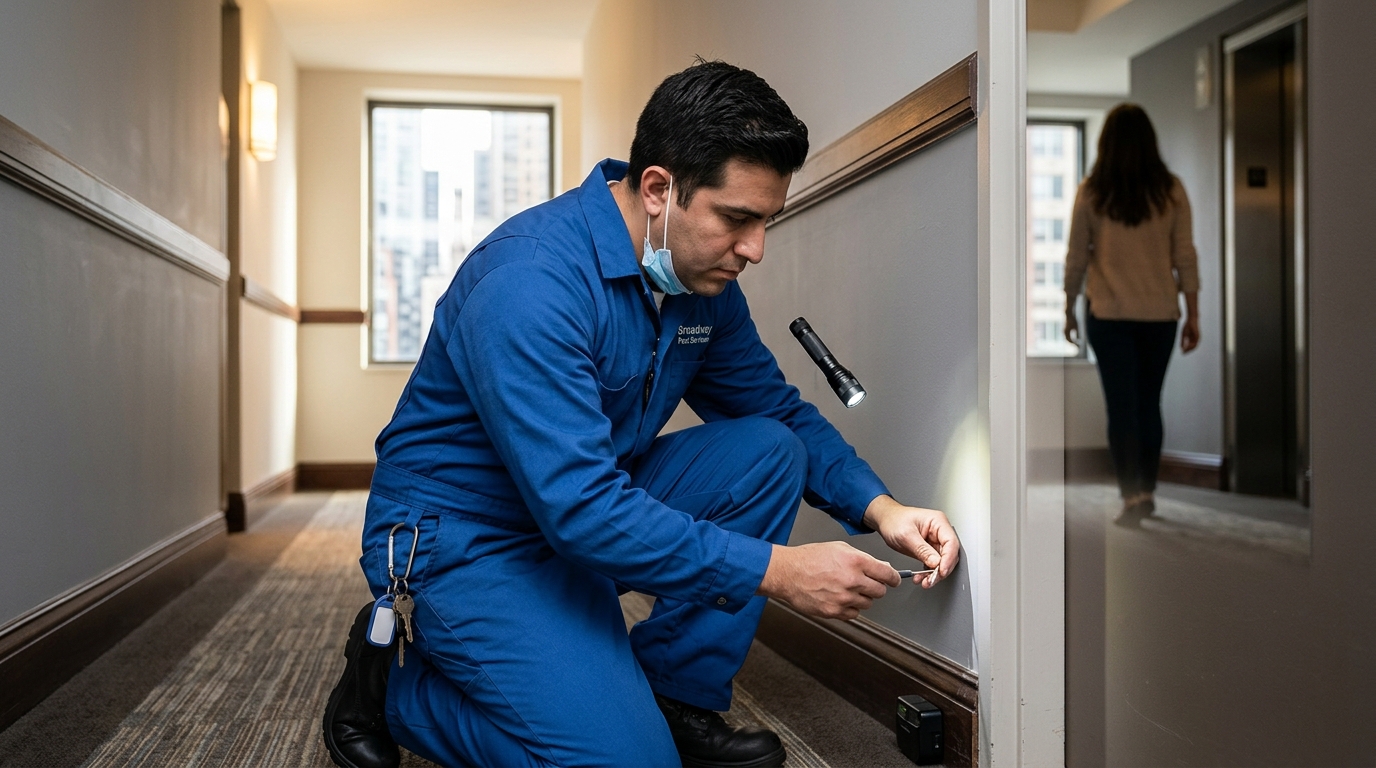
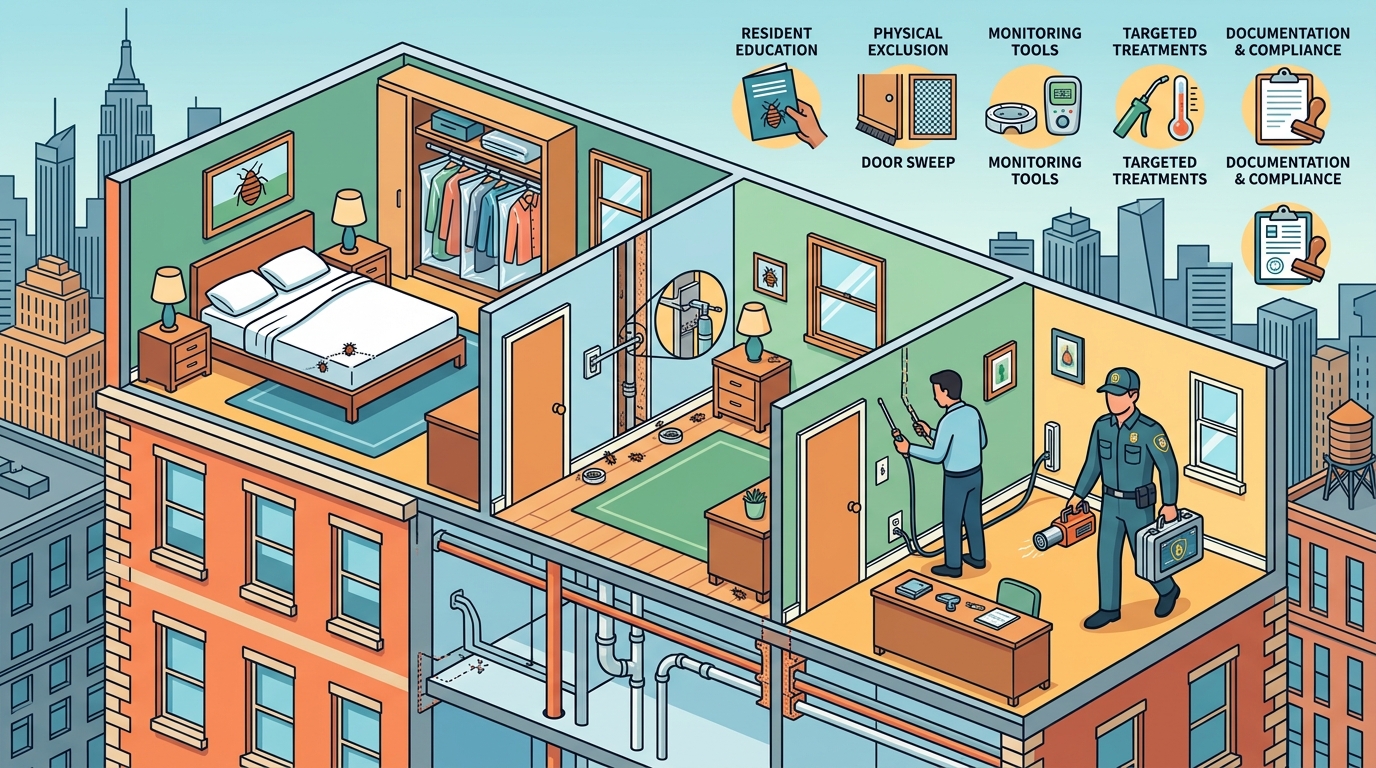
Effective bed bug prevention in apartment buildings requires a multi-layered defense strategy combining resident education, physical exclusion, and targeted chemical or heat treatments. Broadway Pest Services provides this comprehensive approach, ensuring that single-unit infestations do not cascade into building-wide outbreaks. This guide details the specific protocols, monitoring tools, and coordination frameworks necessary to protect multi-family housing in dense urban environments.
Resident Education and Reporting
Resident education is the first line of defense in any multi-family housing pest control program. Bed bugs are highly mobile and often travel through luggage, clothing, and furniture. When residents understand how these pests move, they are more likely to report early signs of infestation rather than hiding the problem out of embarrassment. Broadway Pest Services emphasizes that early reporting is critical because bed bugs can survive up to three months without a blood meal, meaning a vacant unit does not solve the problem; it merely pauses it.
Identifying Early Warning Signs
Residents must be trained to recognize the subtle indicators of an infestation. These include small rust-colored stains on mattresses, tiny black or dark brown droppings, and shed skins. A single verified bed bug complaint on a hotel or rental review platform can trigger an average 18% drop in booking rates or tenant retention for the following 30 days. Therefore, building management must create a non-punitive reporting culture where residents feel safe disclosing sightings immediately.
Pre-Move-In and Move-Out Protocols
Education extends to the turnover process. New tenants should be provided with a checklist for inspecting their unit before bringing in furniture. Similarly, outgoing tenants must be required to leave the unit in a pest-free condition. Broadway Pest Services recommends that property managers include specific clauses in lease agreements that mandate immediate notification of any pest activity, ensuring that the building-wide response can be triggered before the infestation spreads to adjacent units.
Heat Treatment Fundamentals
Heat treatment is a chemical-free method of bed bug elimination that raises the temperature of a room to a level lethal to all life stages of the insect. Bed bugs die at temperatures above 120 degrees Fahrenheit, but eggs require sustained heat to be destroyed. This method is particularly effective in dense urban environments where chemical resistance is a growing concern. Broadway Pest Services utilizes heat treatment as a core component of its commercial and residential protocols, ensuring that the entire lifecycle is addressed simultaneously.
Why Heat Works
Unlike insecticides, which may fail if the bed bugs have developed resistance, heat is a physical force that cannot be resisted. The heat penetrates into cracks, crevices, and furniture where bed bugs hide. A single female webbing clothes moth, for example, lays 40 to 50 eggs over three weeks, but bed bugs have a similar reproductive pressure. By raising the ambient temperature, heat treatment kills the adults, nymphs, and eggs in one pass, preventing the next generation from hatching.
Limitations of Heat
While highly effective, heat treatment has limitations. It requires careful monitoring to ensure that all areas of the room reach the target temperature. If a cold spot remains, bed bugs can survive and re-infest the area later. Broadway Pest Services uses calibrated sensors to map the thermal distribution of a room, ensuring that no harborage site is missed. This precision is what distinguishes professional heat treatment from DIY attempts that often fail due to uneven heat distribution.
Building-Wide Coordination
Bed bugs do not respect unit boundaries. In a multi-family building, an infestation in one apartment can easily spread to the units above, below, and adjacent through shared wall voids, electrical outlets, and plumbing chases. Building-wide coordination is therefore not optional; it is a necessity. Broadway Pest Services approaches every apartment building infestation as a structural issue, not a single-unit problem. This requires a coordinated response that involves all affected units and potentially the entire building.
The 3x3 Rule
Industry standard practice often follows the 3x3 rule, which dictates that if a unit is infested, the units directly above, below, and on either side must also be inspected and treated. This is because bed bugs can travel through the building's infrastructure. Broadway Pest Services implements this protocol rigorously, ensuring that the perimeter of the infestation is contained before the core is treated. This prevents the "whack-a-mole" scenario where one unit is cleared, only to be re-infested from a neighboring unit that was not addressed.
Communication with Tenants
Coordination also involves clear communication with tenants. Broadway Pest Services works with property managers to notify affected residents of the inspection and treatment schedule. This transparency helps reduce anxiety and ensures that residents are prepared for the process, which may involve moving furniture or vacating the unit temporarily. The documentation generated during this coordination is also critical for compliance with local housing regulations and for protecting the property's reputation.
Integrated Pest Management (IPM)
Integrated Pest Management (IPM) is a long-term strategy that combines multiple methods to control pests in an economical and environmentally sensible way. In the context of bed bugs, IPM is the only approach that produces lasting results. It moves beyond reactive spraying to a proactive system of prevention, monitoring, and targeted treatment. Broadway Pest Services is fully IPM-compliant, maintaining all required documentation on behalf of property managers. This approach is mandated by local laws in many jurisdictions, including New York City's Local Law 55, which requires building owners to use IPM practices rather than routine pesticide application.
Prevention and Exclusion
The first pillar of IPM is prevention. This involves sealing entry points, such as gaps around pipes and door thresholds, to prevent bed bugs from entering the building. It also includes managing the building's perimeter to reduce the attraction of other pests that may carry bed bugs. Broadway Pest Services conducts a thorough assessment of the building's structure to identify and seal these vulnerabilities. This physical exclusion is the most effective long-term defense against re-infestation.
Monitoring and Documentation
The second pillar is monitoring. This involves the use of tools like interceptor traps and pheromone traps to detect the presence of bed bugs before they become a visible problem. Every service visit generates a detailed log accessible through Broadway Pest Services' 24/7 client portal. This documentation is not just for the property manager; it is a legal record that satisfies regulatory requirements and provides a history of the building's pest control efforts. In the event of a dispute or a regulatory inspection, this paper trail is invaluable.
Bed Bug Interceptors
Bed bug interceptors are small, shallow cups placed under the legs of beds and furniture. They are designed to trap bed bugs as they climb up or down the legs, providing a physical barrier and a monitoring tool. These devices are a cornerstone of the IPM strategy because they are non-toxic, inexpensive, and highly effective at detecting early-stage infestations. Broadway Pest Services deploys these interceptors as part of its standard monitoring protocol, allowing for the early detection of bed bugs before they establish a colony.
How Interceptors Work
Interceptors typically have a smooth, slippery surface that prevents bed bugs from climbing out once they fall in. Some models include a central well that can be treated with a desiccant or a slow-acting insecticide to kill the trapped bugs. The key to their effectiveness is consistency. They must be checked regularly, and any bugs found must be recorded. This data helps the pest control professional understand the movement patterns of the bed bugs and adjust the treatment strategy accordingly.
Placement and Maintenance
Correct placement is critical. Interceptors should be placed under each leg of the bed, ensuring that the bed frame does not touch the wall. If the bed touches the wall, bed bugs can bypass the interceptor. Broadway Pest Services educates residents on proper placement and maintenance, ensuring that the interceptors remain effective over time. This simple step can save a property manager thousands of dollars in treatment costs by catching an infestation in its infancy.
Advanced Heat Treatment Methods
While basic heat treatment involves raising the temperature of a room, advanced methods utilize specialized equipment to achieve more precise and efficient results. Broadway Pest Services employs a combination of portable heaters, fans, and thermal sensors to create a controlled environment that ensures uniform heat distribution. This is particularly important in complex apartment layouts where furniture and built-in features can create cold spots. The goal is to reach a core temperature of 120 degrees Fahrenheit in all areas of the room, including inside mattresses and behind baseboards.
Thermal Mapping
Advanced heat treatment relies on thermal mapping. Before the treatment begins, the technician places sensors in various locations around the room. As the temperature rises, the data from these sensors is monitored in real-time. This allows the technician to adjust the placement of heaters and fans to eliminate cold spots. Broadway Pest Services uses this technology to ensure that the treatment is not just effective, but also efficient, minimizing the time the unit is out of service.
Post-Treatment Verification
After the heat treatment is complete, the room must cool down gradually. This is important because rapid cooling can cause condensation, which may lead to mold growth. Broadway Pest Services monitors the cooling process and verifies that no bed bugs remain. This is often done using a combination of visual inspection and the use of canines, which are highly sensitive to the scent of bed bugs. This multi-layered verification ensures that the treatment was successful and that the unit is safe for re-occupancy.
Mattress Encasements
Mattress encasements are zippered covers that completely enclose the mattress and box spring. They serve two primary functions: they trap any bed bugs already inside the mattress, preventing them from escaping to feed, and they prevent new bed bugs from entering the mattress to establish a colony. Broadway Pest Services recommends the use of certified bed bug-proof encasements as a standard part of its prevention program. These encasements are a simple, non-chemical method that provides long-term protection for one of the most common harborage sites for bed bugs.
Choosing the Right Encasement
Not all encasements are created equal. To be effective, an encasement must be certified as bed bug-proof. This means that the zipper is designed to prevent bed bugs from entering or exiting, and the fabric is tight enough to prevent them from squeezing through. Broadway Pest Services advises property managers to invest in high-quality, certified encasements rather than cheap, uncertified alternatives. The cost of a good encasement is a small fraction of the cost of treating a full infestation, making it a wise investment for any multi-family property.
Long-Term Protection
Once a mattress is encased, it should remain encased for at least one year. This is because bed bugs can survive for up to three months without a blood meal, and eggs can take up to two weeks to hatch. By keeping the mattress encased for a full year, you ensure that any bed bugs or eggs trapped inside will die of starvation. This provides a long-term barrier that protects the mattress and reduces the need for repeated chemical treatments. Broadway Pest Services includes the installation of encasements in its standard treatment protocol, ensuring that the most critical harborage site is secured.
Interceptor Trap Monitoring
Interceptor trap monitoring is a proactive strategy that uses the data collected from bed bug interceptors to guide treatment decisions. Rather than treating a unit on a fixed schedule, the pest control professional uses the presence or absence of bugs in the interceptors to determine when and where to apply treatments. This data-driven approach is a key component of IPM and allows for more targeted and efficient pest control. Broadway Pest Services uses this monitoring data to create a dynamic treatment plan that adapts to the specific conditions of each building.
Interpreting the Data
The data from interceptor traps is not just a binary yes or no. The number of bugs found, their life stage (egg, nymph, or adult), and their location within the building all provide valuable information. For example, finding only nymphs in an interceptor may indicate a new infestation, while finding adults may indicate an established colony. Broadway Pest Services analyzes this data to determine the severity of the infestation and the appropriate response. This level of detail is what allows for a precise and effective treatment strategy.
Long-Term Trends
Over time, the data from interceptor traps can reveal trends in pest activity within a building. This can help property managers identify patterns, such as seasonal spikes in activity or specific units that are more prone to infestation. Broadway Pest Services provides regular reports on this data, allowing property managers to make informed decisions about their pest control budget and strategy. This long-term perspective is essential for maintaining a pest-free building and protecting the property's value.
Insecticide Application
Insecticide application is a critical component of bed bug control, but it must be done correctly to be effective. Broadway Pest Services uses a combination of gel baits and residual sprays, applied in a targeted manner. The goal is not to spray the entire room, but to treat the specific harborage sites where bed bugs are likely to be found. This targeted approach minimizes the amount of pesticide used and reduces the risk of resistance development. All products used are EPA-registered and approved for use in residential and commercial settings.
Targeted Application
Bed bugs hide in cracks and crevices, so the insecticide must be applied in these specific areas. This includes the seams of mattresses, the joints of furniture, and the gaps around baseboards and electrical outlets. Broadway Pest Services technicians are trained to identify these harborage sites and apply the insecticide precisely. This ensures that the bed bugs are exposed to the pesticide when they return to their hiding spots, maximizing the kill rate.
Resistance Management
Bed bugs have developed resistance to many common insecticides, including pyrethroids. To combat this, Broadway Pest Services uses a rotation strategy, alternating between different classes of insecticides to prevent the bed bugs from developing resistance. This is a key aspect of IPM and ensures that the chemical control remains effective over time. The documentation of which products were used and when is maintained in the client portal, providing a clear history of the resistance management strategy.
Comparison of Bed Bug Control Methods
| Method | Primary Function | Effectiveness | Cost | Duration |
|---|---|---|---|---|
| Resident Education | Early Detection | High | Low | Ongoing |
| Heat Treatment | Elimination | Very High | High | One-time |
| Interceptor Traps | Monitoring | Medium | Low | Ongoing |
| Mattress Encasements | Prevention | High | Low | Long-term |
| Insecticide Application | Elimination | Medium | Medium | Recurring |
Key Takeaways
- Resident education is the first line of defense; early reporting prevents building-wide outbreaks.
- Heat treatment is a chemical-free method that kills all life stages of bed bugs, including eggs.
- Building-wide coordination is essential; the 3x3 rule ensures that adjacent units are treated.
- Integrated Pest Management (IPM) combines prevention, monitoring, and targeted treatment for lasting results.
- Bed bug interceptors provide a non-toxic way to monitor for early-stage infestations.
- Mattress encasements trap existing bed bugs and prevent new ones from entering the mattress.
- Interceptor trap monitoring uses data to guide treatment decisions, making pest control more efficient.
- Insecticide application must be targeted and rotated to prevent resistance development.
Frequently Asked Questions
How long does it take to eliminate bed bugs from an apartment building?
The timeline for eliminating bed bugs from an apartment building depends on the severity of the infestation and the methods used. A single unit may be cleared in one to two weeks, but a building-wide infestation can take several months. Broadway Pest Services uses a combination of heat treatment, insecticide application, and monitoring to ensure that the infestation is fully eradicated. The 30/60/90 follow-up schedule is designed around the bed bug's biology, ensuring that any remaining eggs are hatched and treated.
Are heat treatments safe for residents and pets?
Heat treatments are generally safe for residents and pets, but they require the unit to be vacated during the treatment. The high temperatures can be uncomfortable and may damage heat-sensitive items. Broadway Pest Services provides clear guidelines on what to remove from the unit before the treatment. After the treatment, the unit is cooled down and verified to be safe for re-occupancy. Pets should be kept away from the treated area until the temperature has returned to normal.
How often should interceptor traps be checked?
Interceptor traps should be checked at least once a week. This frequency allows for the early detection of any new bed bugs that may have entered the unit. Broadway Pest Services recommends that residents check their traps regularly and report any findings to the property manager. This data is crucial for the pest control professional to adjust the treatment strategy and ensure that the infestation is fully controlled.
Do mattress encasements kill bed bugs?
Mattress encasements do not kill bed bugs directly, but they trap them inside the mattress. Once trapped, the bed bugs will eventually die of starvation because they cannot escape to feed. This process can take several months, which is why it is recommended to keep the mattress encased for at least one year. Broadway Pest Services uses certified encasements that are designed to be completely bed bug-proof, ensuring that no bugs can enter or exit.
What is the 3x3 rule in bed bug control?
The 3x3 rule is a standard practice in multi-family housing pest control. It dictates that if a unit is infested with bed bugs, the units directly above, below, and on either side must also be inspected and treated. This is because bed bugs can travel through shared wall voids and plumbing chases. Broadway Pest Services implements this rule rigorously to contain the infestation and prevent it from spreading to other parts of the building.
How does Broadway Pest Services document its services?
Broadway Pest Services uses a 24/7 client portal to document all service visits. Each visit generates a detailed log that includes the date, time, technician license number, areas treated, products used, and the next scheduled visit. This documentation is accessible to property managers at any time and satisfies regulatory requirements for Integrated Pest Management. It also provides a clear history of the building's pest control efforts, which is valuable for compliance and for protecting the property's reputation.
Conclusion
Protecting apartment buildings from bed bug outbreaks requires a comprehensive, multi-layered approach. By combining resident education, physical exclusion, and targeted treatments, property managers can create a resilient defense against these persistent pests. Broadway Pest Services brings over 50 years of experience in urban tactical pest control to this challenge, providing the documentation and expertise that NYC's demanding commercial and residential clients require. To plan your visit and secure your property, for a free assessment.