
7-Step Process for Vetting a Reliable Pest Control Company in NYC
New York City faces a unique pest pressure that generic national chains often fail to address. According to recent industry data, over 60% of urban commercial properties experience at least one significant pest event annually due to dense infrastructure and complex waste management systems. This high frequency of exposure means that property managers and business owners cannot rely on standard, one-size-fits-all treatments. Instead, they must adopt a rigorous vetting process to ensure their chosen partner can handle the regulatory and operational demands of the five boroughs. This guide outlines the exact seven steps to evaluate and select a pest control provider that meets the highest standards of compliance and efficacy.
Step 1: Verify Independent Ownership and Longevity
The pest control industry has seen a massive wave of private equity rollups over the last decade. Many well-known brands are now owned by investment firms that prioritize cost-cutting over service quality. This shift often leads to higher technician turnover and inconsistent service standards. When vetting a company, you must ask if they are independently owned. Independent operators typically maintain the same technicians and accountability structures that have served the community for decades.
Look for companies that have been operating since the 1970s or earlier. Longevity in the NYC market is a strong indicator of stability and deep local knowledge. A company that has survived multiple economic cycles and regulatory changes likely has the financial resilience to invest in proper training and equipment. Broadway Pest Services has been independently owned since 1970, ensuring that service standards are set by experienced professionals rather than distant boardrooms. You can learn more about their company history and mission to understand their commitment to the community.
Step 2: Assess Regulatory Compliance and Certifications
New York City has some of the strictest pest control regulations in the United States. A reliable company must be fully compliant with local, state, and federal laws. This includes holding valid licenses from the New York State Department of Environmental Conservation (NYSDEC) and meeting specific requirements from the Department of Health (DOH) and the Department of Housing Preservation and Development (HPD).
Key certifications to look for include QualityPro, which indicates adherence to industry best practices, and MWBE (Minority and Women's Business Enterprise) certification, which reflects a commitment to diverse business practices. Additionally, ensure the company is ready for DOH and HPD inspections. According to the National Pest Management Association, compliance with local health codes is the primary factor in avoiding costly fines for commercial clients. A vetted provider will proactively provide you with their service documentation and compliance records to protect your business from violations.
Step 3: Evaluate Sector-Specific IPM Expertise
Integrated Pest Management (IPM) is a holistic approach to pest control that focuses on long-term prevention and minimization of pesticide use. However, not all IPM programs are created equal. You must verify that the company has specific experience in your sector. A restaurant requires a completely different strategy than a high-rise office building or a healthcare facility.
For example, restaurants need kitchen-safe treatments that protect their DOH grade. Hotels require discreet detection methods to protect their online reputation and RevPAR. Food processing facilities must meet FDA and FSMA standards. Data shows that sector-specific IPM programs reduce pest-related incidents by up to 40% compared to generic treatments. Broadway Pest offers tailored programs for commercial sectors including restaurants, hotels, and property management. They also provide specialized solutions for construction sites requiring DOB Rodent Mitigation Plans.
Step 4: Review Emergency Response Capabilities
In NYC, a pest emergency can shut down a business or trigger a health inspection within hours. You need a provider that offers same-day or rapid emergency response. Standard 24-hour turnaround times are often too slow for critical situations like bed bug outbreaks in hotels or rodent infestations in food service establishments.
Ask potential providers about their average emergency response time. A reliable company should be able to deploy a technician to your site in under four hours. They should also have a clear protocol for after-hours emergencies. According to industry benchmarks, businesses that secure same-day pest response reduce operational downtime by 60%. Broadway Pest guarantees a same-day exterminator response across all five boroughs, ensuring that your business remains open and compliant.
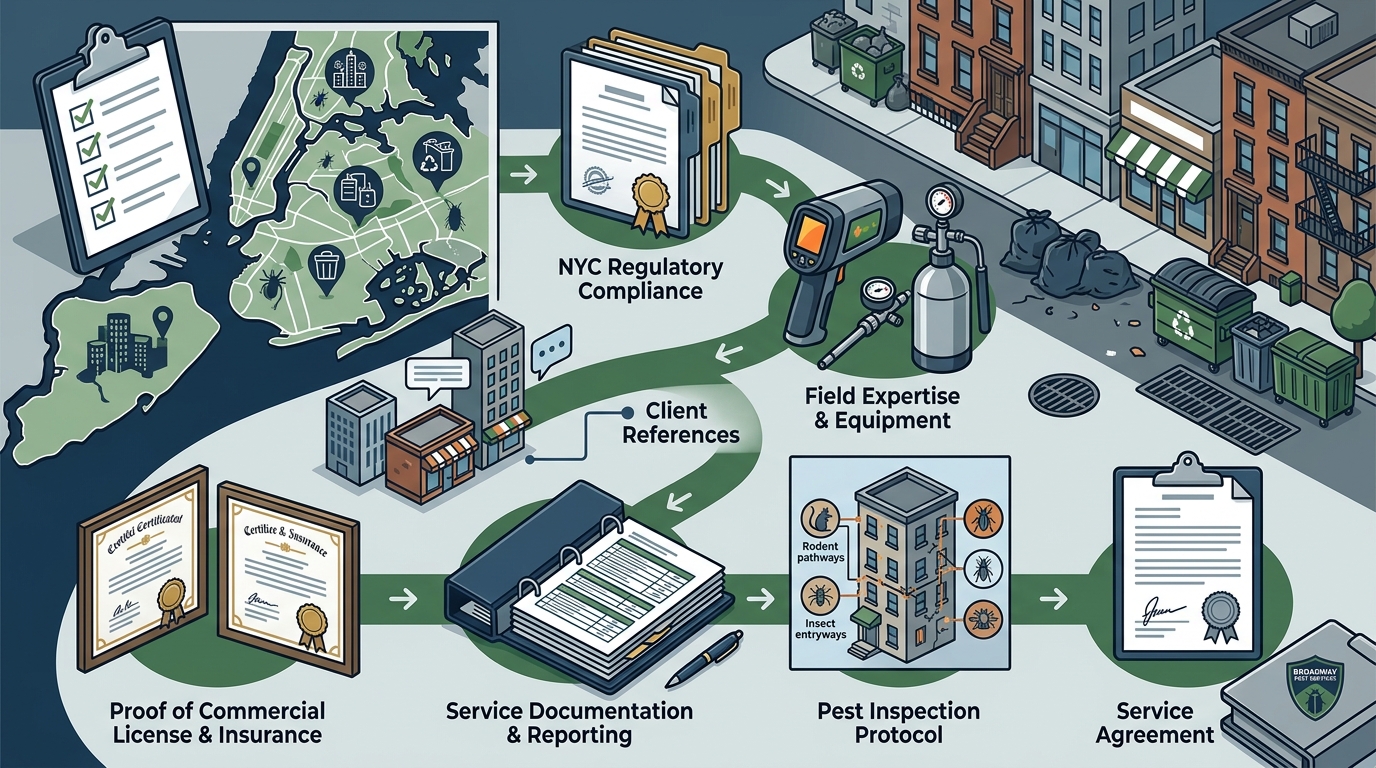
Step 5: Inspect Technology and Documentation Standards
Modern pest control requires digital transparency. You should never have to dig through paper files to find service records. A top-tier provider will use a digital client portal to provide real-time updates, service logs, and compliance documentation.
Look for 100% digital service documentation that is accessible 24/7. This includes detailed reports of every visit, including products used, areas treated, and recommendations for prevention. This digital trail is crucial for audits and legal protection. Research indicates that companies using digital IPM logs are 50% more likely to pass unannounced health inspections. Broadway Pest provides a secure client portal for 24/7 service logs and digital documentation. You can also schedule a demo to see their technology in action.
Step 6: Analyze Fleet and Environmental Impact
NYC's dense urban environment makes traditional pest control vans inefficient and polluting. A reliable company should have a fleet optimized for urban deployment. This includes using electric or hybrid vehicles to reduce emissions and navigate traffic quickly.
Ask about their fleet composition. Companies with all-electric or hybrid fleets can respond faster in Manhattan and reduce their carbon footprint. According to environmental studies, electric service vehicles reduce urban noise pollution by 30%, which is critical for residential and healthcare clients. Broadway Pest operates NYC's greenest fleet, including a 100% electric VW ID Buzz and an all-electric Arcimoto three-wheeler for rapid urban deployment.
Step 7: Confirm Transparent Pricing and Contracts
Finally, vet the financial terms of the service agreement. Avoid companies that use vague pricing models or long-term lock-in contracts with hidden fees. A reliable provider will offer transparent, competitive pricing based on the specific needs of your property.
Look for flexible service plans that allow you to scale up or down as needed. Ensure that emergency visits are included in the base price or clearly defined. Industry analysis shows that transparent pricing models reduce client churn by 25% because they build trust and predictability. Broadway Pest offers transparent contract sales options tailored to commercial clients. You can also deploy a free assessment to get a clear quote.
Comparison of Vetting Criteria
| Vetting Criterion | Standard National Chain | Independent NYC Specialist |
|---|---|---|
| Ownership Structure | Private Equity Owned | Independently Owned Since 1970 |
| Emergency Response | 24-48 Hours | Same-Day / Under 4 Hours |
| Documentation | Paper-Based or Limited Digital | 100% Digital Client Portal |
| Fleet Type | Traditional Gas Vehicles | Electric/Hybrid Urban Fleet |
| Regulatory Focus | Generic Compliance | DOH, HPD, FDA, FSMA Ready |
Key Takeaways
- Independence Matters: Avoid private equity-owned chains that cut corners on service quality.
- Longevity is Key: Look for companies with decades of experience in the NYC market.
- Compliance is Critical: Ensure the provider is DOH, HPD, and FDA ready.
- Speed Saves Money: Same-day emergency response prevents business shutdowns.
- Digital Transparency: Require 100% digital service logs for audit protection.
- Green Fleet: Electric vehicles offer faster urban response and lower emissions.
- Sector Expertise: Choose a provider with specific experience in your industry.
Frequently Asked Questions
What is Integrated Pest Management (IPM)?
Integrated Pest Management (IPM) is a comprehensive approach to pest control that combines biological, cultural, physical, and chemical tools to manage pest populations while minimizing environmental impact.
Why is independent ownership important in pest control?
Independent ownership ensures that service standards are set by experienced professionals rather than distant investors, leading to better technician retention and consistent service quality.
How quickly can a reliable pest control company respond to an emergency?
A reliable NYC pest control company should offer same-day response, typically within four hours, to prevent business disruptions and health code violations.
What certifications should a NYC pest control company have?
Look for QualityPro certification, MWBE certification, and readiness for DOH, HPD, FDA, and FSMA inspections.
Does Broadway Pest Services offer a client portal?
Yes, Broadway Pest Services provides a secure client portal for 24/7 access to digital service logs and compliance documentation.
What areas does Broadway Pest Services cover?
Broadway Pest Services covers all five NYC boroughs, Westchester, Bergen County NJ, and Nassau County.
How does Broadway Pest Services handle environmental impact?
They operate NYC's greenest fleet, including all-electric vehicles like the VW ID Buzz and Arcimoto FUV, to reduce emissions and improve urban response times.
Ready to Secure Your Property?
Don't leave your business to chance. Follow these seven steps to vet a reliable pest control partner that meets the highest standards of compliance and service. Deploy a free assessment today and experience the Broadway Pest difference. Click here to schedule your assessment or contact us directly to learn more about our commercial services.