

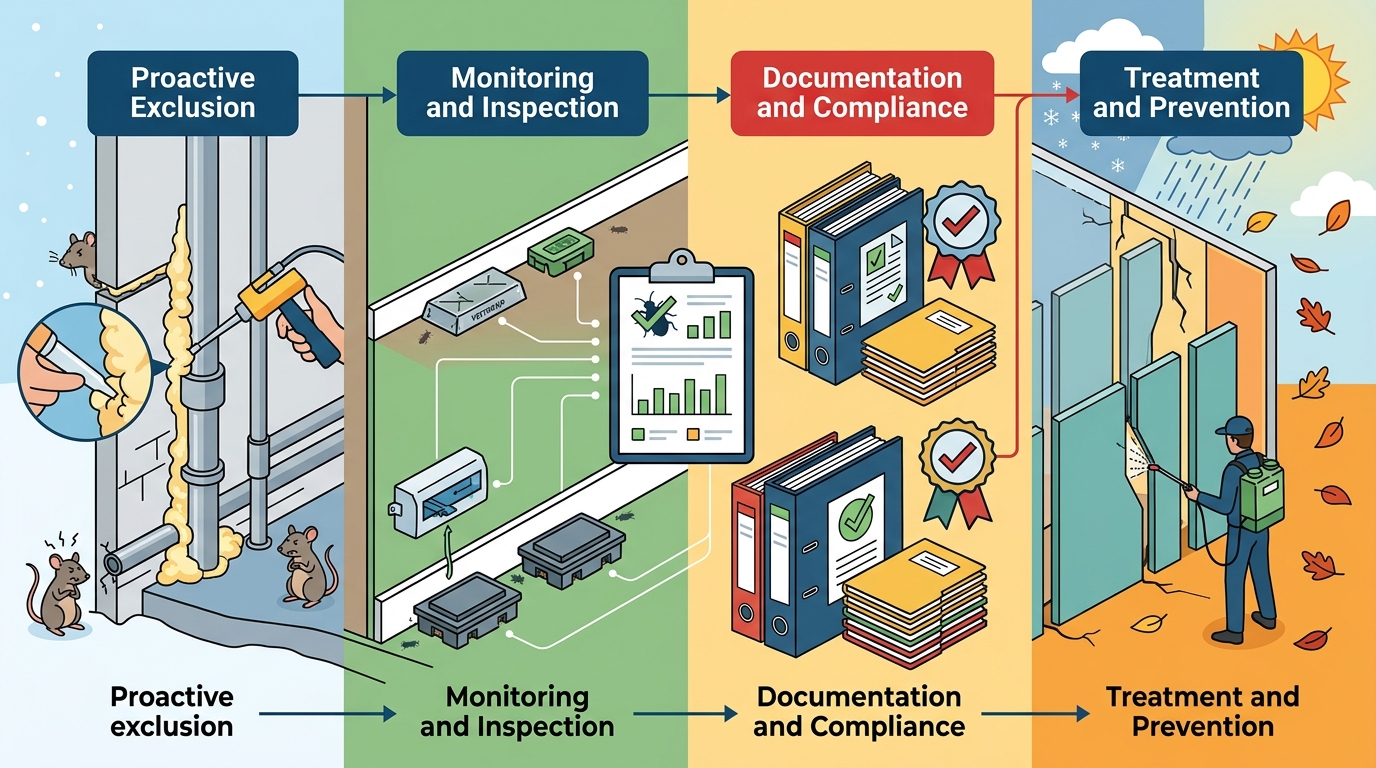
NYC property managers should implement year-round Integrated Pest Management (IPM) by combining proactive exclusion, continuous monitoring, and rigorous documentation. This approach prevents infestations before they trigger HPD violations or tenant complaints. Broadway Pest Services helps property managers build these compliance-ready systems to protect their portfolios.
Understanding IPM in NYC Buildings
Integrated Pest Management is the implementation of diverse methods of pest controls, paired with monitoring to reduce unnecessary pesticide applications. In the dense urban environment of New York City, this definition takes on a critical operational meaning. Standard spraying alone does not address the root causes of infestations in aging building stock. Property managers must shift from reactive extermination to a proactive, data-driven management system.
The New York City Department of Health and Mental Hygiene emphasizes that building owners are required to keep apartments and common areas free of pests. NYC Health regulations mandate that property managers maintain premises free from pests, but they also expect a strategy that goes beyond simple chemical application. IPM focuses on identifying why pests are present, fixing those conditions, and using targeted treatments only when necessary. This approach aligns with the expectations of both housing and health inspectors.
For property managers, IPM is not just a maintenance task; it is a risk management tool. It protects the building's reputation, ensures tenant safety, and provides a legal defense against violations. By adopting IPM, managers demonstrate due diligence. This shifts the narrative from neglect to active, professional management. Broadway Pest Services designs these programs specifically for the unique challenges of NYC's commercial and residential real estate.
Structural Exclusion and Entry Point Sealing
Exclusion is the most effective long-term strategy in any IPM program. It involves physically preventing pests from entering the building. In NYC, where buildings are often pre-war or have decades of patchwork construction, entry points are abundant. Sealing cracks, gaps around pipes, and damaged screens is a permanent solution, whereas chemical treatment is temporary.
Consider a typical 1920s brownstone in Harlem or a mid-century office tower in Midtown. These structures have extensive entry points through aging foundations, original plumbing chases, and service corridors. Rodents and cockroaches exploit these gaps to move between units and buildings. A single unsealed gap under a door or around a utility line can allow an entire colony to establish itself. Property managers must conduct thorough inspections to identify and seal these vulnerabilities.
The implication of proper exclusion is a significant reduction in pest pressure. When pests cannot enter, the need for chemical interventions drops dramatically. This leads to lower costs and a healthier indoor environment for tenants. Broadway Pest Services specializes in exclusion-first rodent elimination, ensuring that every entry point is documented and sealed. This foundational step is critical for any year-round IPM strategy.
Continuous Monitoring and Threshold-Based Action
Monitoring is the engine of an IPM program. It involves the systematic use of traps, glue boards, and visual inspections to track pest activity levels over time. This data drives treatment decisions. Instead of treating on a fixed calendar schedule, managers treat based on actual activity thresholds. This is what separates IPM from spray-and-pray extermination. according to Integrated Pest Management
For example, a property manager in a multi-family building in Brooklyn Heights might install glue boards in basements, boiler rooms, and common areas. If the boards show no activity for three months, no treatment is needed. If activity spikes, it triggers a targeted response. This data-driven approach ensures that resources are used efficiently. It also provides a clear record of the building's pest status over time.
The implication of continuous monitoring is early detection. Catching a small infestation before it spreads saves money and prevents tenant complaints. It also allows for the identification of trends. For instance, a seasonal spike in rodent activity might indicate a need for better exterior sanitation or exclusion. Broadway Pest Services uses digital monitoring tools to log this data, providing property managers with real-time insights into their building's pest profile.
Documentation for HPD and DOH Compliance
Documentation is the product of a professional IPM program. Pest control is the service, but the records are what protect the property manager. In NYC, inspectors do not just ask if you have pests; they ask what you are doing about pest risk. Compliance means being able to produce accurate logs, invoices, inspection notes, and trend reports the moment someone reviews records or walks the property.
Every service visit should generate a detailed log. This log should include the date, time, technician license number, areas inspected, activity observed, treatments applied, and the next scheduled visit. These records are accessible 24/7 and are ready for HPD inspectors or housing court proceedings. A single 311 pest complaint can trigger an HPD inspection within one to two weeks. Without documented IPM showing proactive mitigation, the inspector will likely cite a violation. With it, you have a defensible record.
The implication of strong documentation is legal protection. It can prevent citations entirely or help win cases at OATH if cited. It also demonstrates active management, which is a strong defense against 7A receivership proceedings for buildings with patterns of uncorrected violations. Broadway Pest Services provides timestamped digital service logs that are built for HPD housing court defense. This level of documentation is essential for any property manager operating in NYC.
Seasonal Adjustments for Urban Pest Pressure
Pest pressure in NYC is not static; it fluctuates with the seasons. A year-round IPM strategy must account for these changes. In the summer, heat and humidity drive pests indoors in search of water and shelter. In the winter, rodents seek warmth and move into buildings. Property managers must adjust their monitoring and exclusion efforts accordingly.
For instance, in the fall, rodent activity often increases as animals look for winter shelter. This is the time to intensify exterior monitoring and ensure that all entry points are sealed. In the spring, insect activity rises, requiring increased attention to interior monitoring and sanitation. By anticipating these seasonal shifts, property managers can stay ahead of infestations. This proactive approach is a hallmark of a mature IPM program.
The implication of seasonal adjustment is consistent protection throughout the year. It prevents the common mistake of relaxing efforts during off-peak seasons. Pests do not take a break, and neither should your IPM program. Broadway Pest Services designs annual IPM programs that evolve with the property, incorporating seasonal adjustments to maintain continuous protection. This ensures that the building remains compliant and pest-free in every month of the year.
Key Takeaways
- IPM is a proactive, data-driven approach that reduces reliance on chemical pesticides.
- Structural exclusion is the most effective long-term strategy for preventing infestations.
- Continuous monitoring with threshold-based action ensures efficient and timely responses.
- Rigorous documentation is essential for HPD and DOH compliance and legal defense.
- Seasonal adjustments are necessary to address fluctuating urban pest pressure.
- Partnering with a specialized provider like Broadway Pest Services ensures compliance-ready IPM.
Frequently Asked Questions
What is the primary difference between IPM and traditional pest control?
IPM focuses on prevention and data-driven decision-making, while traditional pest control often relies on reactive chemical treatments. IPM aims to solve the root cause of infestations, whereas traditional methods may only address the symptoms.
Why is documentation so important for NYC property managers?
Documentation serves as legal proof of due diligence. It can prevent HPD violations, defend against tenant complaints, and protect the property from receivership proceedings. Inspectors expect to see records of proactive pest management.
How often should property managers conduct IPM inspections?
Inspections should be conducted on a regular schedule, often monthly or quarterly, depending on the building's risk profile. Monitoring data should drive the frequency of more detailed inspections.
Can IPM programs be customized for different property types?
Yes, IPM programs should be tailored to the specific risks of each property. Restaurants, hotels, and multi-family housing all have different pest pressures and compliance requirements.
What role does sanitation play in an IPM program?
Sanitation is a critical component of IPM. Eliminating food, water, and shelter sources reduces the conditions that allow pests to establish. It works in tandem with exclusion and monitoring.
How does Broadway Pest Services support property managers with IPM?
Broadway Pest Services provides documented, compliance-ready IPM programs. They offer exclusion-first strategies, continuous monitoring, and 24/7 access to digital service logs for HPD defense.
Conclusion
Implementing year-round IPM strategies is not optional for NYC property managers; it is a necessity for compliance and risk management. By focusing on exclusion, monitoring, and documentation, you can protect your portfolio and your reputation. Broadway Pest Services brings over 50 years of NYC expertise to your property, providing the tactical pest control and compliance documentation you need. to schedule a free assessment and build a protection plan that holds up on inspection day.